
Selling online in Thailand used to mean one of two things: a shop on Shopee or Lazada, or a Facebook page with a lot of "inbox me" comments. Both work. But more and more of the businesses we talk to want their own online store, where the customers, the brand and the margins are theirs. The question is always the same: what will it cost?
This guide covers both halves of the answer: what it costs to build an online store in Thailand, and what it costs to run one every month. That second number is the one most people underestimate.
What an online store costs to build
In Thailand, a professionally built online store usually starts from around ฿32,000 and can go past ฿160,000. Where you land depends mostly on three things: how many products you sell, how they vary (sizes, colours, bundles), and how much of the process should run without you touching it.
Store size Typical build price Good for
Small catalogue (up to ~50 products) ฿32,000 – ฿60,000 A brand with a focused range, gifts, cosmetics, local products
Medium store (hundreds of products, variants) ฿60,000 – ฿120,000 Fashion with sizes and colours, home goods, multiple categories
Store with custom features ฿120,000 – ฿160,000+ Wholesale prices, subscriptions, booking, links to stock or accounting systems
Our own e-commerce package starts from ฿32,000 for a store with your products, a cart, a checkout with Thai payment options and order emails, live in a few weeks. Larger catalogues and custom features are quoted in writing before we start. You can compare it with our other website packages and prices.
Shopify, WooCommerce or custom: which one?
The platform choice affects both the build price and the running costs, so it's worth understanding before you compare quotes.
Shopify
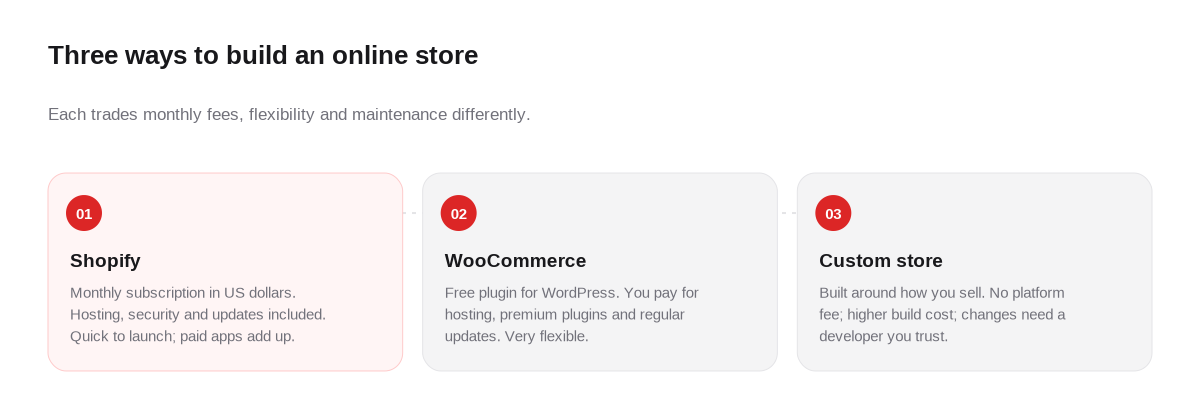
A hosted platform: you pay a monthly subscription (in US dollars), and Shopify looks after the servers, security and updates. It's quick to launch and easy to manage yourself. The trade-offs are the subscription that never stops, paid apps for extra features, and some limits on how far you can customise the checkout.
WooCommerce (WordPress)
Free to install, very flexible, with a plugin for almost everything. But "free" means you pay for hosting, premium plugins and, most importantly, someone to keep WordPress, the theme and the plugins updated. An unmaintained WooCommerce store is a common target for hackers.
A custom-built store
Built around exactly how you sell, with no monthly platform fee and nothing you don't need. It suits brands with a clear process, special pricing rules, or a need to connect the shop to other systems. The build costs more up front, and you need a developer you trust for changes.
For most small Thai brands, the right answer is the one that keeps monthly costs predictable and lets you add products and promotions yourself. Ask every quote to spell out the monthly costs, not just the build price.
Payments in Thailand: what your store must accept
Thai customers expect to pay the way they pay everywhere else. At minimum, a Thai online store should accept:
- PromptPay QR: the national QR payment that almost every Thai banking app can scan. For many shops, this is the most used option.
- Credit and debit cards: Visa and Mastercard, for Thai and international customers.
- Mobile banking and e-wallets: depending on the payment provider, direct payment from popular banking apps and wallets.
You connect these through a payment gateway. Providers available to Thai businesses include Opn Payments (formerly Omise), 2C2P, GB Prime Pay, the major Thai banks' own gateways, and Stripe. Each charges a fee per transaction, usually higher for cards and lower for PromptPay, and the rates depend on your business and sales volume. Always check the provider's current price list before choosing. Our guide to online payments for Thai websites compares the options in more detail.
Cash on delivery is still popular for some products in Thailand. If your customers ask for it, make sure your store and your courier support it. Plan for the returns that come with it too.
Shipping, stock and the day-to-day
The cart and checkout are the visible part. Behind them, your store needs answers to some very practical questions:
- Shipping rates: flat rate, free over a minimum order, or calculated by weight? Which couriers (Thailand Post, Kerry, Flash, J&T…) and who prints the labels?
- Stock: is the website the only place you sell, or do you also sell on Shopee, Lazada, LINE and in a physical shop? Selling the same stock in several places without overselling needs a plan.
- Order notifications: where should new orders appear? Email, LINE, a dashboard? Who checks them, and how fast?
- Tax documents: do business customers need a full tax invoice? That affects what the checkout must collect.
None of this is exciting, but it is where online stores quietly fail. A beautiful shop that sends orders to an inbox nobody checks will lose customers fast.
The monthly running costs
Here is what an online store typically costs to keep running, beyond the one-time build:
- Platform or hosting: a Shopify subscription, or hosting for WooCommerce or a custom store.
- Payment fees: a percentage of every online payment, set by your gateway.
- Apps and plugins: reviews, upsells, shipping integrations. They add up quickly, so check what is truly needed.
- Domain and email: small yearly and per-user costs.
- Maintenance: updates, backups, fixing things when a payment provider or courier changes its system.
- Marketing: ads, content, promotions. Without traffic, even the best store sells nothing.
Your own store or a marketplace?
Marketplaces bring traffic you would otherwise have to pay for. Their fees and commissions come with it, and so do rules you don't control and customers who belong to the platform. Your own store costs more effort to fill with visitors, but every customer, every email address and every repeat order is yours.
Many successful Thai brands do both: marketplaces for reach, their own website for brand, margins and repeat customers. A simple approach is to use marketplace listings to find new buyers, then give them a reason (a member price, a free gift, faster replies on LINE) to order from your website next time.
How to plan your budget
- Count your products and their variants. That number shapes the build more than anything else.
- List the payment methods your customers already use. PromptPay is almost always one of them.
- Write down who will add products, answer orders and ship parcels. The tools should fit those people.
- Ask for the build price and the expected monthly costs in writing.
- Start with what you need to sell well now. Loyalty points, subscriptions and wholesale portals can come later.
If you're planning an online store, have a look at our e-commerce website development service, or tell us what you sell. We reply within 24 hours with a fixed price in Thai baht.
A quick checklist
- Specify SKUs and variations
- Request payment and shipping demos
- Test complete order lifecycle
- Budget for gateway fees and support
Frequently asked questions
How much does an online store cost in Thailand?
A professionally built online store usually starts from around ฿32,000 for a small catalogue and can exceed ฿160,000 for large stores with custom features. Monthly running costs come on top.
Can my website accept PromptPay?
Yes. Most Thai payment gateways support PromptPay QR, and customers can pay by scanning the code with their banking app.
Is Shopify or WooCommerce cheaper in Thailand?
Shopify has a predictable monthly subscription and little maintenance. WooCommerce has no subscription but needs hosting, plugins and regular updates. Over two or three years the totals are often closer than people expect.
Should I sell on Shopee and Lazada or build my own website?
Many brands do both: marketplaces for reach, their own website for their brand, margins and repeat customers.
How long does it take to build an online store?
A small store can be live in a few weeks once products, photos and prices are ready. Larger catalogues and custom features take longer.
Is WooCommerce itself free?
The core plugin is free, but hosting, design, extensions, gateway fees and maintenance may cost money.